A Year on the EuroPython Society Board
Last year I announced that I’d be running for the EuroPython Society board in this article. My main goals were simple: to learn, to grow, and to give back to the community that gave me so much.
Most of what happened this year was the result of many people contributing their time, ideas, and energy, so this is as much a reflection on working together as it is on my own role.
Time
Over the past year, I took on two major roles: leading the design and comms team, and vice-chairing the non-profit itself. I tracked my time in my calendar, which is open to the whole EuroPython Society organization. Below is a breakdown of my time.
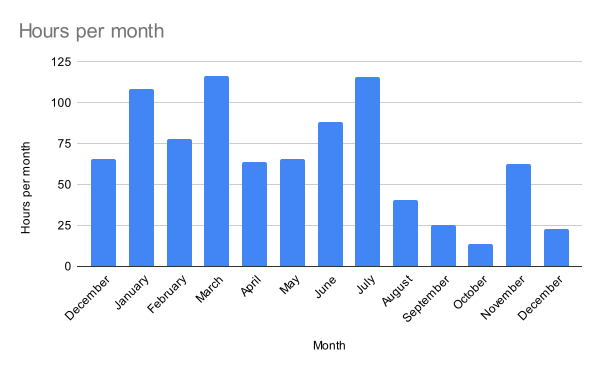
As you can see, there are a few clear peaks:
- March was by far the busiest month. Most of the website work happened then, we opened ticket sales, and there was a lot of logistics, comms, and design work, as well as coordination with sponsors.
- July was the second biggest peak, which is expected since that’s when the conference took place.
- January was busy with opening the Call for Proposals, design and comms work, conference promotion, and my own onboarding.
- June was also intense, as it was the final stretch before the conference. A lot of work focused on comms and design, along with finalizing sponsor deals.
Design
I had never been part of a design team before, and picking up something completely new was a challenge. Luckily, several people from the community were happy to jump in, especially Raquel who helped with defining the list of items that need to be designed, which I’m very grateful for.
I enjoy being creative, throughout the whole process I learned a lot, and the overall experience was so positive that I’m happy to lead design next year as well!
I also had the opportunity to hire a designer, Adriana, who helped as a volunteer a year before, and she created lots of assets that were later on reused for different designs. I learned tremendously from our collaboration.
Here’s a list of some of the things that I’ve accomplished:
- We often talk about what to do, but what’s even more important is what not to do. My first task was to decide what not to design. Sustainability matters, so it doesn’t make sense to spend time designing things that don’t actually need custom design. Many things can also be moved to the website, and it’s easier to do that in Astro than to draw them in Figma.
- When we do need to design items, it’s important to know what to focus on and what to simplify. This year, we simplified a lot of things to preserve time, money, and energy. For example, after more colorful t-shirt design in 2023 and 2024, we returned to a monochromatic version for 2025. This made production cheaper and easier.
- I reviewed all the tools we use for design. Canva was recommended to me because it has tons of templates and is very easy to work with. I created a project there and imported our assets. This turned out to be a great decision, because it unblocks people from other teams to create their own materials. Canva also has a special tier for non-profits, so if you’re running one, I definitely recommend checking it out.
- I also automated a lot of things. I wrote a small banner generator so others wouldn’t have to manually recreate assets every time. The goal was to make it easier for anyone in the team to produce visuals without having to figure out dimensions and safe areas for different social media platforms. If you use multiple platforms and need banners, feel free to reuse it! Here’s the link: https://clytaemnestra.github.io/social-banner-generator/
- This year, for the first time, we had speaker cards on social media. These were generated automatically from the website, all with a single command!
- We reused the same code to create sponsor cards as well. Since all logos and sponsorship tiers already live on the website, using it as the source felt like the obvious choice.
For next year, I want to focus even more on design and hire a local designer from the 2026 location. I already have mockups and ideas for a design system that’s very close to my heart, and I’m incredibly excited to start working on it!
Comms
The biggest chunk of my time went into comms. That includes social media, newsletters, emails, YouTube, basically everything public-facing.
Some of the things I improved:
- We have a new website. The previous one was missing some important information, especially when preparing lightning talks. Daksh, a community member and professional web designer, created the initial mockups, and Marcin, who’s skilled in front-end development, helped bring the new site to life. My role was mostly about coordination: thinking through what we needed, giving feedback, and reviewing pull requests. I’m not a front-end developer, but I learned a lot about both web development and marketing along the way. I especially enjoy working at the intersection of tech, creativity, and design, and collaborating with people who care deeply about what they’re building.
- We worked on it mainly as a team of two, together with Marcin, with regular input from occasional contributors and people actively using the site. Waking up to new commits every morning was great, but even more rewarding was seeing the site finally reflect what participants and speakers actually need. The momentum of building something continuously and watching it evolve day by day gave me a lot of energy and genuine joy!
- We continued producing shorts on our YT channel. I strongly believe that if we want to attract more young people, and we should, we have to be on the platforms they use, like Instagram, TikTok, and YouTube. While we were at PyCon US, we recorded shorts with EuroPython speakers who were there. It was super fun! What made this possible was how generous speakers were with their time. Many were happy to record a short on the spot, even in the middle of a busy conference! And if someone had told me I’d end up having a short with Guido, I wouldn’t have believed them. Yet here we are! https://www.youtube.com/shorts/cgKZG5EfWdI
- Automation played a big role in comms as well. I already mentioned automated speaker and sponsor cards, but scheduling social media posts was automated too. We used the website together with Zapier and Buffer to programmatically schedule around 120 speaker posts and 20 sponsor posts. That kept our social media channels active for months.
- Another big automation project was generating shorts from long YouTube videos. I vibe-coded a script that takes a full video, transcribes it, finds interesting moments, cuts the video, zooms in on the speaker’s face, and adds TikTok-style subtitles. We already have a few of these on our YouTube channel. For example, here’s one with Savannah, generated by running a command and waiting about 15 minutes: https://www.youtube.com/shorts/uqLc-vNkbKA. The script still produces a lot of clips that aren’t very interesting, but it’s good enough. It usually generates around 20 shorts, out of which 5 or 6 are usable, and that’s already a big win.
- Media partnerships. I think media partners are extremely important. We have limited capacity, and the more people we have helping to spread the word, the easier it gets. This year I secured a few media partnerships and we ended up collaborating together. Fun fact: if you were listening to Radio Rock Beat in the Czech Republic, you might have heard my voice starting with Ahoj bíťáci (I know, super cringe) and promoting EuroPython. Super random, but definitely fun! I was on a rock radio, woohoo!
Board
Being on the board and vice-chairing was challenging, mostly because most of the board, except for two people, was new. That meant a lot of learning and sometimes building processes from scratch.
Some of the things I worked on that I’m proud of:
- We hired an event manager. This was a big win. Our event manager, Anežka, is the most amazing event manager we could have, and it also proved that hiring part-time or full-time help completely makes sense. I was involved in the hiring process and in weekly coordination calls, which taught me a lot, not only about hiring and working with contractors and suppliers, but also about event management itself.
- For the first time ever, we had a booth at PyCon US, which was honestly super cool. It gave us the opportunity to talk to many community members in one place, gather feedback, and promote EuroPython. We also managed to close some sponsorship deals along the way.
- Monthly reports. We started producing reports about the work we do. Even though we’re an organization run by volunteers, I think it’s important to be accountable and transparent. We paused during conference season because things got busy, but it’s a step in the right direction and I hope we can resume it in January.
- Board wiki. We documented processes and workflows, which was especially useful since almost everyone needed onboarding. The documentation has a lot of room for improvement and is definitely not perfect, but having everything in one place is still much better than having nothing at all.
- Finance. I also did some finance work and finally gained a better understanding of how things actually work. Going through all the processes myself was painful at times, but very useful. Next year, I’d like to offload more of this to paid staff.
- I was also part of the sponsorship team. The board usually acts as a backup for teams and steps in when help is needed, and the sponsorship team needed extra support, so I joined in. Fundraising doesn’t really spark joy for me, but it was still useful to understand how it works and see that side of the organization.
- UX research with open source contributors. We ran UX research calls where we talked to open source contributors about how we could make the conference better for them. This was mostly about listening. People were very open about what they’re missing at conferences, and a lot of the direction we took came directly from those conversations. The idea is that if we attract more OSS contributors, they can collaborate with each other, work on their tools, and also create workshops and talks for developers, who are our main audience. More OSS contributors also means richer and better content for everyone. We also launched an open-ended questionnaire to collect ideas from the community. One clear theme that came out of the research was interest in more core CPython topics and more open spaces. Based on this, the chair and I decided to gently push the conference in that direction. We asked the program team to aim for CPython-related keynotes and proactively worked on reaching out to interesting speakers asking them to submit a proposal. We received feedback from attendees after the conference that they were very happy with the technical keynotes. We also had a screening of a documentary featuring core developers and other community members, which was super cool.
- I’m especially happy that after so many years, it looks like the CPython Language Summit will take place at EuroPython instead of PyCon US. The idea is to alternate between the two events and give people a chance to attend if traveling to the US is difficult.
- Last but not least, we had the biggest conference ever, and it took the least effort to put together. I’m incredibly proud of what the team managed to pull off together.
Looking ahead
Here are a few things I’d like to focus on for next year.
Design
We definitely need a new local design. I already have a mockup of the new logo and can’t wait to start working on it and eventually show it to the world! The design process last year was very smooth, so if everything goes as well again, I’ll be more than happy!
Comms
My main goal for 2026 is to build a proper comms team. This year, I ended up doing most of the comms work myself, which was a great learning experience, but also showed me that having a team would be much more sustainable. We have plenty of ideas and if you’d like to join me next year, please reach out 🙂
On top of that, I have a few ideas I’d like to try. I want to grow our reach through “influencer marketing”, so we rely less on ourselves and more on community amplification. For example, we could invite people to promote EuroPython on their social media, blogs, or podcasts. Social platforms are accessible to almost everyone, so we could also run a campaign where people share conference promos, with some rewards
We should also expand our media partnerships. Last year was more of a pilot, so we only had a few. Next year, I’d like to build a larger program with more local partners.
Overall, my goal is to build a strong internal team while also relying more on external partners. This would make the setup more resilient and less dependent on any single person.
Board
I firmly believe we should hire a second, local, event manager to better distribute the workload and improve sustainability.
Finance is another area I want to improve. I’d like to outsource more of it this year and streamline our processes.
The big thing is obviously the new location. There’s VAT setup, contracts, team building, logistics, and everything that comes with it. I’m really looking forward to it. EuroPython has been in Prague for the last three years, so I haven’t had the chance to see the full setup process from start to finish.
With all that said, I’ll be running for the vice-chair position again!
If you’d like to reuse some of my tools, need help organizing an event, or just have feedback or comments, feel free to reach out to me at mia@europython.eu or on any of the social platforms I’m on!
At the end, I want to explicitly thank everyone who contributed this year, from board members and volunteers to speakers, media partners, and participants. None of this would exist without people showing up, often quietly and unpaid, and that’s something I don’t take for granted.